
CARNIVAL IN SAN SALVATORE
San Salvatore Monferrato | Leisure/Family
22 February 2026
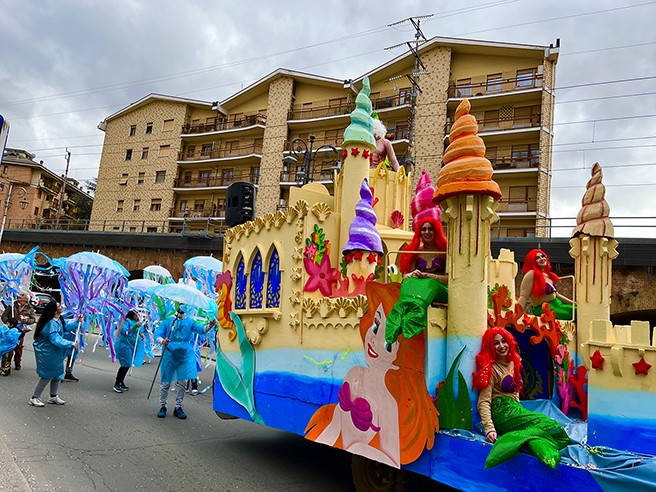
Carnival arrives in San Salvatore with the "Businà 2026"
In addition to the parade of floats, on the afternoon of Saturday the 14th, as per tradition,
the new dialect "Businà" will be recited. Author Mario Lombardo recalls an episode from 80 years ago, when as a child he recalls a dispute involving
dialect rhymes between San Salvatore and Castelletto, the famous "Contra-Businà."
When politics was also played out through dialect rhymes
SATURDAY, FEBRUARY 14 – THE PROGRAM
Volunteers from the Oratorio Campanone have been working for over a month in the spaces made available by the Beccaria and Gagliazzo families. They are currently finishing four floats for the parade, which will depart from Piazzale Santa Croce on Saturday, February 14, at 2:30 PM and wind through the city streets, concluding in Piazza Carmagnola around 4:30 PM. Here, the large puppet representing the end of the revelry and the beginning of Lent will be burned in the traditional bonfire.
During the afternoon, the "Businà 2026" will be read, composed by Mario Lombardo, a witty and irreverent author and orator for over 30 years, who will take potshots in dialect rhyme at the powers that be, as only true satire can do, and of course in the strict San Salvatore dialect. In the square, for the little ones, Magician Bingo will return with his show "Il RompiBolle" (The Bubble Breaker), while the Carnival leaders will read the poem marking the end of the revelry that precedes the forty days of pre-Easter penance. Don Gabriele Paganini, who continues the tradition of the "Gran Carvà" of San Salvatore Monferrato, has invited everyone to participate in the parade through the streets of the historic center, with floats reserved for children dressed in free-form costumes and parades and floats tied to the 2026 theme: magic.
In San Salvatore Monferrato, Saturday, February 14th, will not only be a celebration of love and the parade of floats, but also the day of Businà 2026, the ancient satirical dialect poem that transforms Carnival into a scathing political platform.
This year, the event takes on an extraordinary historical significance: Mario Lombardo, author and interpreter of the tradition, in addition to reading the verses composed for the 2026 edition, will commemorate the 80th anniversary of one of the most daring episodes in local history.
The Duel of the Squares of 1946 - In February 1946, in an Italy wounded by war and divided by ideologies, the Businà composed and recited in the square of Castelletto Scazzoso (now Monferrato) contained harsh swipes at the Vatican. The response was not long in coming: the assistant priest of San Salvatore, Ermenegildo Gonella (the famous Don Gunèla), responded by composing the famous Contra
Businà cui d’Castlèt.
The witness's memory - Mario Lombardo, a very young altar boy following the priest at the time,
still recalls the tension of that moment: I remember the fear I felt. I felt like my Don had exaggerated. We entered our neighbors' square, and he courageously spoke up, reading aloud verses in dialect.
To dismantle the thesis proclaimed by the people of Castelletto, Gonella cited the phrase that Pope Pius XII uttered in support
of non-belligerence: "Nothing is lost with peace, while everything can be lost with war." He criticized the choices of the fascist dictatorship and was unsparing in his judgments on the role of "crafty Russia" in the world conflict.
Thus, through rhymes and dialect, a challenge from another era unfolded: a verbal duel where ideology gave way to wit, leaving posterity with the memory of a divided but extraordinarily vibrant Italy.
From the streets to social media: satire today - While in Castelletto and many municipalities in the Alessandria area the tradition has died out, San Salvatore endures. Where once there were battles over ideologies, today Lombardo's Businà points the finger at contemporary problems: from the exorbitant costs of the Strait of Messina Bridge to the state of public roads. An event that invites reflection on how the debate has changed: from the deep yet light-hearted, sonorous laughter of the streets, in dialect, to the often angry tones of television talk shows and social media.
15046 San Salvatore Monferrato


- Home
-
-
- Events calendar
-
-
Areas of interestAccomodation
- Photographic Archive
-
-
-
-
Tourist information
