
San Sebastiano martire
Useful information for your stay
piazza Roma, 1 - 15050 San Sebastiano Curone (AL)
Tel. +39 (0131) 786.128
Tel. +39 393 940.3564
http://www.diocesitortona.it
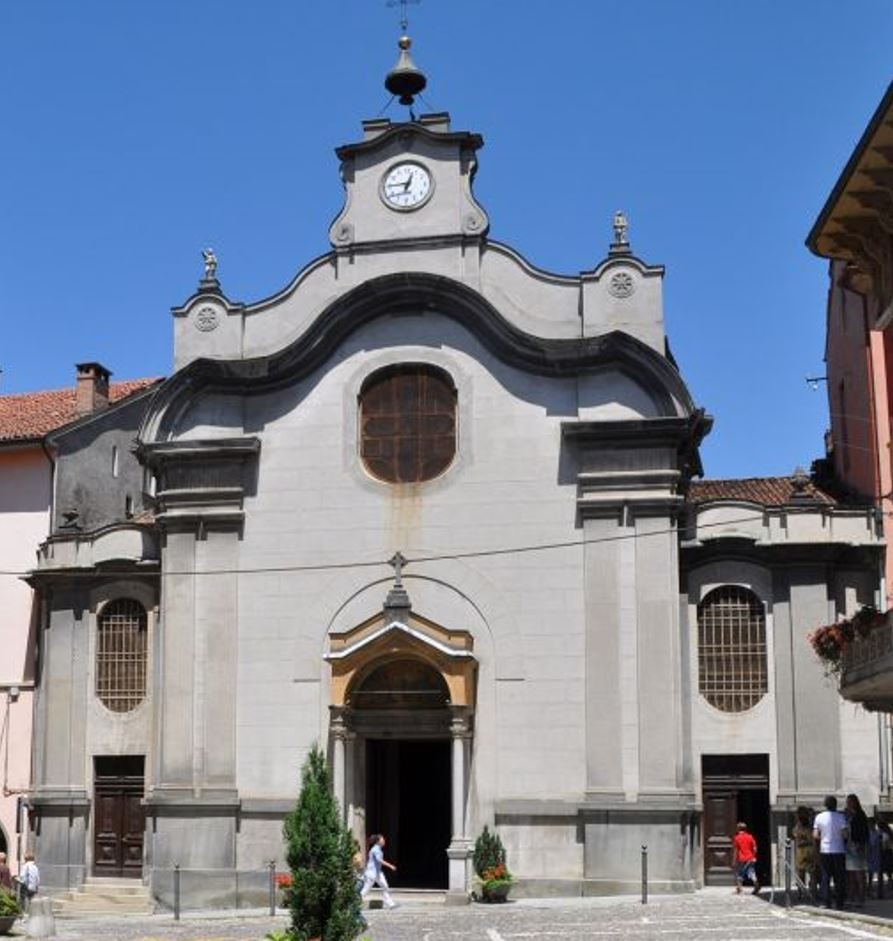
The parish church, in Piazza Roma, was built on the site of a small chapel dedicated to Saint Sebastian, from which the town and the church itself took their name. The building appears to date back to the 16th century; subsequent restorations have given it its current appearance.
Several notable works are housed within.
The apse houses the Martyrdom of Saint Sebastian, an oil on canvas with a non-contemporary stucco frame. The painting was created in the second half of the 17th century by the Genoese painter Giò Raffaele Badaracco. The martyr, diagonally descending to the left, is depicted against a dark background, his head tilted back, his gaze turned to the sky, his lips parted in an act of invocation, his wrists tied with ropes to crossed poles, and three arrows stuck in his body. At the feet of the saint is a shield decorated with a frieze. In front of the saint are two Roman archers about to shoot more arrows. The figure of Saint Sebastian is illuminated by a light filtering through the clouds, while two cherubs offer him a garland of roses and the palm of martyrdom. In the background is a village that may represent a view of the town from its time. The painting was restored in 2013.
Another representation of Saint Sebastian is located on a side altar. It is a polychrome wooden sculpture dating back to the 19th century and attributed to the sculptor Luigi Montecucco of Gavi Ligure, creator of numerous wooden groups that adorn various churches in our area. The Saint is positioned vertically, in an act of invocation to heaven, his left wrist tied to a felled tree, with a decorated shield at his feet. The martyr's light colors are typical of purism. This statue is carried in procession through the streets of the town on May 8th each year, the Feast of the Vow.
In the left aisle is a Crucifixion, attributed to the German Stephen VII and part of the wooden sculpture created between the late 16th and early 17th centuries by Northern masters settled in the Alexandrian area. The work was restored in 2014 under the direction of the SBSAE Piedmont. The scene of the Cross is depicted as described by Saint John in his Gospel: "Now by the cross of Jesus stood his mother, and his mother's sister, Mary the wife of Clopas, and Mary Magdalene." In the foreground, the group of figures includes Our Lady of Sorrows, center, and, from left to right, Mary the wife of Clopas, the mother of the sons of Zebedee, Mary Magdalene, John, Peter, and another woman. The background, behind the Cross, depicts the walls of Jerusalem.
The Altar of the Rosary features a Madonna and Child in polychrome and gilded wood at the center, surrounded by canvases from the Rosary cycle. The work's characteristics suggest a 17th-century Genoese wooden sculpture.
Baby Jesus Appearing to Saint Anthony of Padua, an oil on canvas from the second half of the 17th century, is a particularly interesting painting attributed to the workshop of Domenico Fiasella. The Saint, wearing a Franciscan habit, is depicted kneeling, extending his arms toward the Baby Jesus. On the table, covered by a red cloth, are an open book and a lily, a symbol of purity. In the upper part of the painting, six angel heads observe the scene.
The frescoes in the Parish Church are the work of the 20th-century Brera Academy member Francesco Mazzocchi. Interestingly, several of the figures depicted are portraits of San Sebastiano residents who posed for the artist.
The high altar, made of polychrome marble and sculptures, is the work of the Genoese sculptor Solari and was built in 1759, thanks to a donation from the then feudal lord Prince Andrea Doria. Provost Pantaleone Francischelli notes: "In 1755, His Excellency Prince Doria, the patron, came to San Sebastiano for the first time, along with His Excellency the Princess, and having seen the high altar of the church in its entirety, said that marble would be better and would contribute to the cost; therefore, it was decided to have it built in marble, which was agreed upon in 1758 for 1,600 Genoese lire. In 1759, the marble was transported with free passage and duty-free to the states of His Majesty the King of Sardinia, and on July 1st, the work was completed, with the demolition of the old church." (Pietro Giani in: "Cronistoria del Borgo di San Sebastiano").
The wooden choir, of Lombardy-Piedmontese origin and dating to the second half of the 17th century, is composed of seventeen carved walnut stalls.


- Home
-
-
- Events calendar
-
-
Areas of interestAccomodation
- Photographic Archive
-
-
-
-
Tourist information
