
Comune Capriata d'Orba
Useful information for your stay
piazza Garibaldi, 1 - 15080 Capriata d'Orba (AL)
Tel. +39 0143 46102
Fax: +39 (0143) 467.234
E-mail: protocollo@comune.capriatadorba.al.it
Website:
comune.capriatadorba.al.it/
The town appears to have been inhabited since prehistoric times, and archaeological finds suggest it existed in pre-Roman and Roman times. Its name first appears in documents dated 973.
For centuries, Capriata was at the center of political disputes, expansionist ambitions, and wars, which led to its having numerous lords and masters. It was against the Alessandrians, allied with Genoa, then again annihilated by the Alessandrians, returned to the Genoese, and subsequently to the Duchy of Milan, until 1317. It then fell under the rule of the Marquises of Monferrato, and two centuries later it was destroyed first by the French and then by the Spanish in 1648. Finally, in 1708, it became part of the Savoy dominions. The village had a castle and a wall with access gates, and today it is still dominated by the Castel Vecchio, which is not in excellent condition.
The 12th-century tower, also poorly preserved, still presents a massive appearance, a true defensive bastion that was once part of the walls. The fortification and tower may be older: they were, in fact, part of a system of watchtowers already present in the Carolingian era, which means from approximately 750 to 1100, and perhaps even earlier in the Byzantine era.
In the village, you can also find 15th-century houses with decorations and part of their frescoes, as well as many older buildings, which have been visibly adapted for other uses, but which bear witness to a past marked by noble lords.
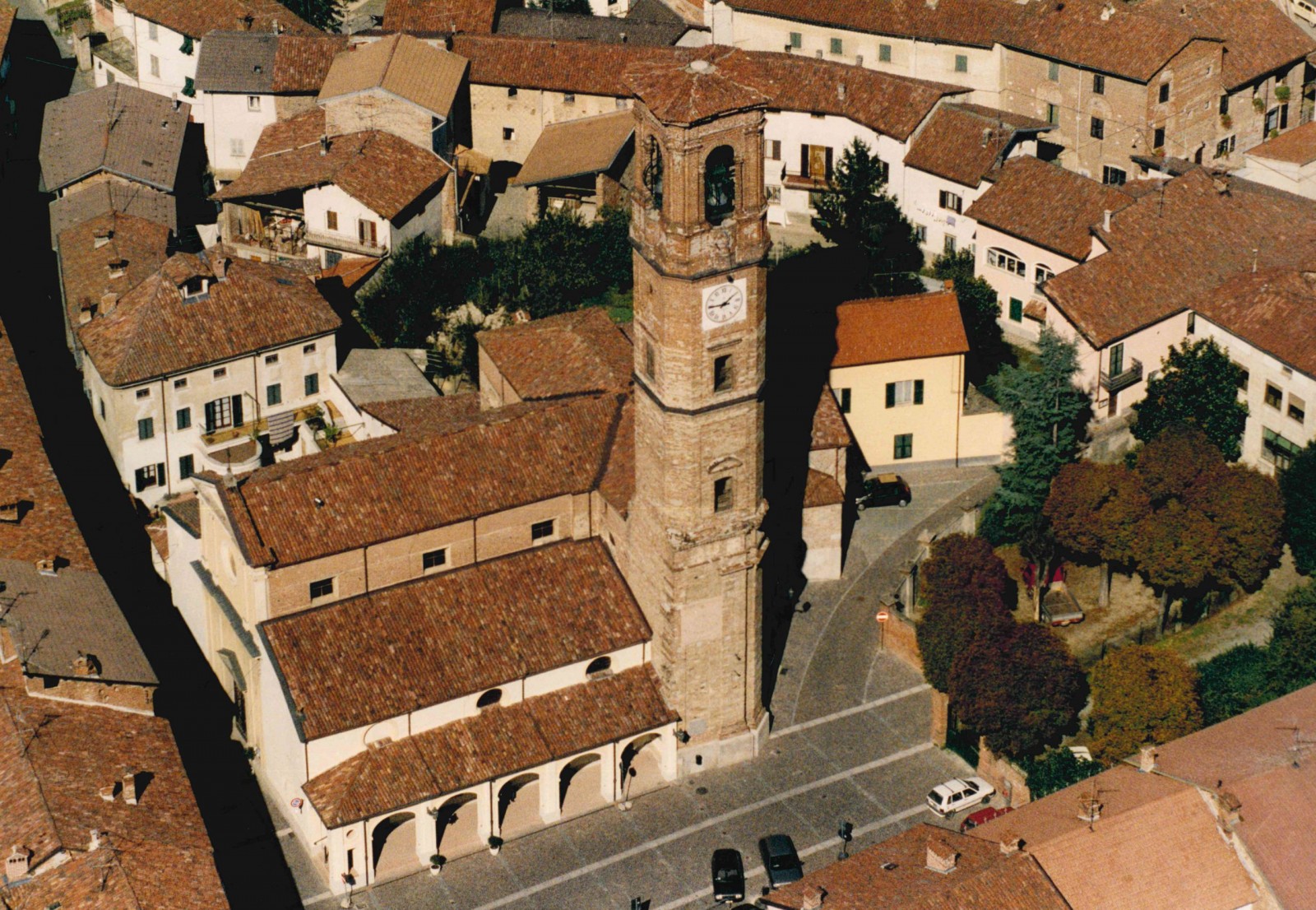
The parish church dedicated to Saints Peter and Paul and Our Lady of the Rosary, with three large naves, was probably built in 1200 and subsequently underwent renovations and modifications, as was the case with almost all churches in the area.
Inside, there are some valuable furnishings, including wooden statues, an altar carved from an unusual black marble, and above all, a recently restored two-and-a-half-by-two-meter canvas attributed to a Ligurian artist, Luca Cambiaso, who was probably the greatest exponent of the Ligurian style in the 16th century.
What's unmistakable about the village are the two tall Baroque bell towers and a pair of small churches towards the outer edge of town: San Rocco and the Chapel of the Madonnetta.


- Home
-
-
- Events calendar
-
-
Areas of interestAccomodation
- Photographic Archive
-
-
-
-
Tourist information
