
Comune Montemarzino
Useful information for your stay
via IV Novembre, 9 - 15050 Montemarzino (AL)
Tel. +39 (0131) 878.124
E-mail: info@comune.montemarzino.al.it
http://www.comune.montemarzino.al.it/
The first reliable records date back to 1081, when the town belonged to the Lords of Gavi, before passing to the Municipality of Tortona in 1098.
In 1164, Frederick Barbarossa granted Montemarzino to Pavia, and it remained in the hands of Pavia until the reconciliation with Tortona. It then passed again to the Lords of Gavi, who ceded it to the Municipality of Genoa, then to the Doria and Spinola families, from whom it passed to the Savoy in the 18th century.
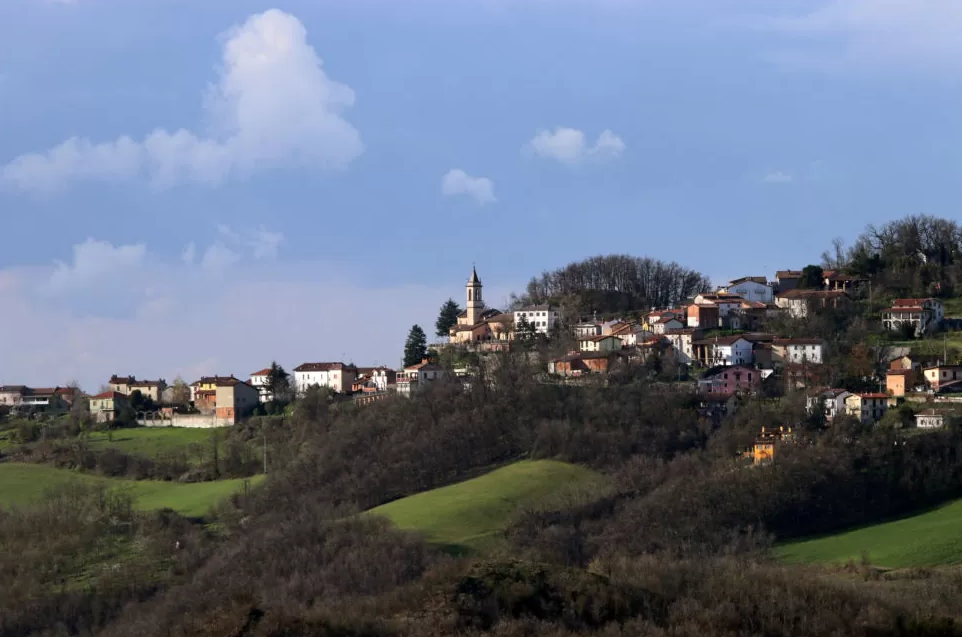
The origin of the name Montemarzino, "Marsen" in dialect, most likely derives from the Ligurian words "mar" (wonderful) and "sen" (view), which almost certainly refer to the privileged location where the castle, of which only ruins remain, was built: on a hill above the town of the capital, which affords a truly magnificent panoramic view.
The municipality's territory lies partly in the Curone Valley and partly in the Grue Valley, and includes the hamlets of Segagliate, Barca, Costa, Reguardia, Roncascinate, and Zebedassi.
The latter once enjoyed fame thanks to a mineral known as "Zebedassite." This is a black stone with pink veins, composed of magnesium and aluminum. It was used for years in the construction of local homes until it was decided to trade it for other uses. In the 20th century, a quarry was opened where the stones were cut to make slabs for the market. Since the quarry was located on the hills near a river, a cableway was built to transport it down the valley more easily and quickly. It still exists today and is visible along provincial road 100. After a few decades, the quarry ceased operation as the stone was gradually replaced by more reliable and easily transportable materials.
The Montemarzino area has been important for the commercial activities of the Curone Valley. In the hamlet of Barca, the remains of a watermill, the Mulino del Bue, still exist today. Over the centuries, it served a significant role not only as a grain mill but also as a source of electricity.
The surrounding area is characterized by lush nature, rich in animal species and wild orchids, with splendid broom bushes that stand out ethereally. Agriculture produces delicious and genuine products such as peaches, apples, pears, and truffles. Local grapes are used to make Timorasso, a deliciously flavorful native wine. From an artistic perspective, Montemarzino offers many historically significant buildings, such as the Romanesque apse of the Church of Santa Maria in Scrimignano and the 18th-century Parish Church of San Giovanni. The Oratory of San Giuseppe dates back to 1709.


- Home
-
-
- Events calendar
-
-
Areas of interestAccomodation
- Photographic Archive
-
-
-
-
Tourist information
